Can water really exist in a form that is a liquid, steam, and ice all at once? And how is this feature useful in the creation of thermometers? The triple point of water explains it all.
In addition to its unusual behavior at low temperatures , water has another interesting property. At a certain temperature and pressure, it can exist simultaneously, and in perfect equilibrium, in a solid, liquid, and gaseous (water vapor) state. This equilibrium form is called the triple point of water, and is quite useful in helping to define and measure temperature.
Zeroth Law Of Thermodynamics
To recall, the zeroth law of thermodynamics states that two bodies in thermal equilibrium with a third are in thermal equilibrium with each other. In other words, two bodies in thermal equilibrium have the same temperature, and we can use a third body, a thermometer, to find this temperature. But we first need to set up a reproducible temperature scale to make this happen. One method is to define zero temperature as the point at which the temperature in a constant volume gas thermometer becomes zero. The second method is to use the triple point of water.
The Mathematics of Triple Point
The triple point of water is defined to take place at 273.16 K, where K is the SI unit Kelvin. Unlike Celsius and Fahrenheit scales, Kelvin is not measured using degrees; we merely say “Kelvin.”
The triple point of water is important enough to merit its own line:
T3 = 273.1K
This is equivalent to 0.01oC and 32.02oF, and thus we use T3 to help set the freezing point of water.
Absolute zero is defined as being equivalent to that of 0 Kelvin, which is -273.15oC and and -459.67oF, and this is a standard that is accepted internationally. It is important to note that the pressure the triple point exists at is 4.58 torr in SI units or .006 atm. To compare, the Earth’s average atmospheric pressure is 1 atm.
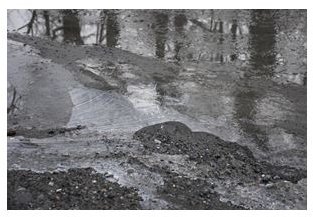
Semi-Frozen Lake: Pennywise
Themal Expansion in Everyday Life
You have observed water existing simultaneously in three states yourself. You voluntarily see it when you add ice to your hot drink of tea, coffee, or chocolate, and then watch the steam rise as the ice melts. You may also see it if you freeze water in an empty soda bottle to create ice, add water, and then generate vapor by blowing into it. The difference is that at the triple point, the total amount of ice, water, and water vapor will not change without a change in temperature and/or pressure. Therefore, on average, the liquid will not freeze or evaporate, the ice will not melt or evaporate, and the water vapor will remain water vapor.