Each buoy a mariner sees gives information. Sometimes it marks a channel- a safe ‘road’ for him or her to use. Sometimes it indicates a danger like a sunken ship in the area to be avoided. Oh_buoy!! How do we figure that out? Read on.
Genesis (click on pic for IALA regions)
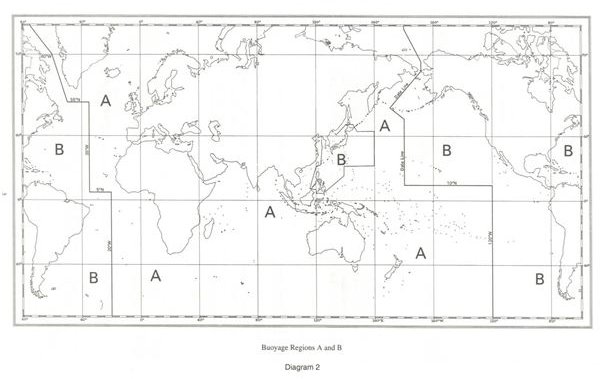
In marine navigation, the wordwide system of buoyage is called the IALA system. In 1979, the International Association of Lighthouse Authorities (IALA) standardised the buoyage system worldwide. Two regions were created region A and region B.
The areas that use the ‘B’ system, are North and South America, Japan and the Philippines. The remainder of the World uses the ‘A’ system.
The IALA systems are made up of five types of buoys, lateral, cardinal, safe water, isolated danger and special. The lateral signs in the Regions A and B are different, but the other four signs (i.e. cardinal, safe water, isolated danger and special) are common (identical) for these both regions.
Lateral Buoys region A and B (In the picture, the bold arrows indicate the channel)

A channel is the route a ship must pass for safety. It is an area in the entrance to a port which has deeper water levels and is clear of any obstruction below the sea.
Region A is also called red to port, because red buoys are on the port (left) side of the channel and green buoys are on the starboard (right) side when entering a harbour (reverse when departing). The ship must pass between them for safety, keeping the red buoy on her port side and the green one on the starboard side.
Region B is exactly the opposite, and is remembered as red to starboard, which means that green buoys mark the port (left) side of the channel and red buoys mark the starboard (right) side of the channel when entering a harbour (reverse when departing). The ship must pass between them for safety, keeping the green buoy on her port side and the red one on the starboard side.
For easy identification, the shapes of the buoys in both regions are different, as can be seen from the diagrams. The topmarks (the small shape at the top of each buoy) are also distinctive and different. At night, the lights on each buoy are different as well.
Cardinal buoys
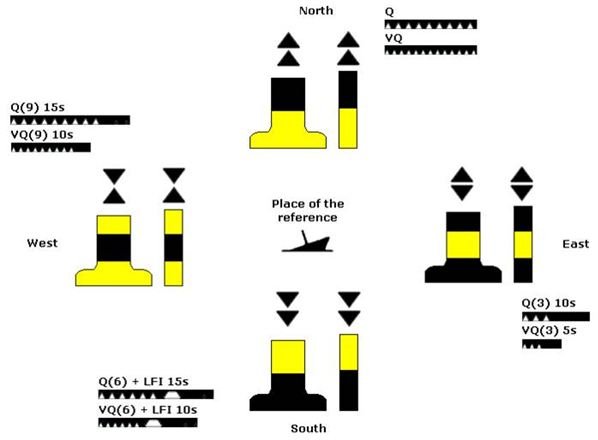
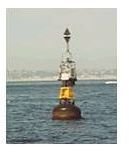
Tell us that the deepest water occurs at the side of the marks name. They are placed to the north, south, east or west from a point of interest, like a wreck. They are painted in horizontal yellow and black stripes, and are of four types. North Cardinal, East Cardinal, SouthCardinal and West Cardinal buoy.
A North cardinal buoy has deepest water North of the buoy, and so a ship must always pass north of the buoy, keeping it to the south. Same for the others.
The pic on the right gives details of all the cardinal buoys with a central point of interest (a wreck). The direction of North is up the page. The colours, topmarks and lights (at night) of each are distinctive. We should pass North of the North cardinal buoy, East of the East Cardinal buoy, and so on.
Safe water, Isolated danger and Special buoys

A safe water buoy (left) tells us that there is safe (deep) water all round the buoy. A ship can pass any side of it.

An isolated danger buoy (right) indicates there is a danger in the immediate vicinity of the buoy, like a wreck. Ships should keep well clear of it.
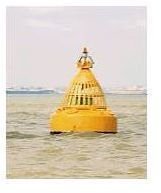
A special buoy (left) indicates a special area or an object mentioned on charts or in other nautical documents and publications. On their own, they may not have great navigational significance.