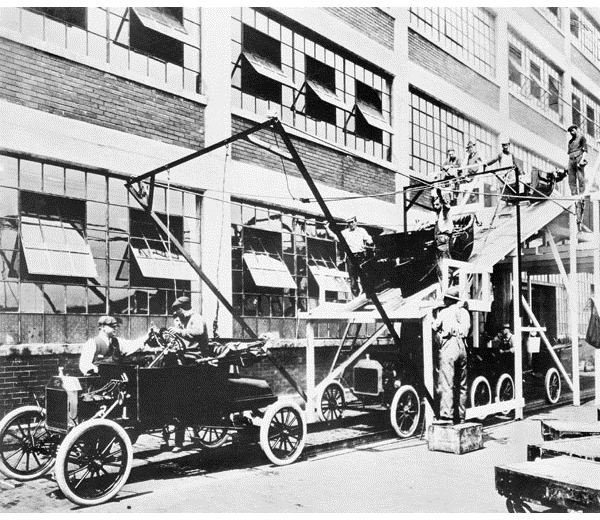
Robots are being extensively utilized in the automotive industry, and in the near future, their application, because of the quality and accuracy produced, will spread to many more industries,
Selecting a Robot
A large range of robots with different components, techniques, and means of operation have already been designed and manufactured. These are selected according to their utility and financial considerations. A futuristic robot, with modern sensors and appropriate software, can perform tasks efficiently, accurately, and quickly, but will be expensive. Thus, all the relevant factors must be considered while selecting robots for industrial applications, including the initial expenditure and the benefits to be achieved in using the robot.
Use Of Robots In Industry
Robots are being beneficially utilized in a vast variety of industries, some of which are:
Loading and Unloading: Robots are extensively being utilized for the loading and unloading of machines and parts in industries, thus substituting human labor and other mechanical methods. Robots possess the benefit of duplicating the designed tasks, performing accurately, and being compatible with the nearby equipment. Future robots are expected to completely substitute human beings in carrying out loading work, positioning tools for machineries, and replacing tools when necessary.
Spot Welding: Robots perform spot welding very accurately, with recurring operations, and are extensively being used in automotive industry. They can extend to places which normally would be difficult to reach by manual welding.
Arc Welding: The surroundings of arc welding are unsafe for the fitness of human beings, and achievement of quality welds is difficult by manual operations. Therefore, since smooth movements provide superior welds, the use of robots for such operations is growing very rapidly. Utilization of industrial robots for arc welding is economical, and the welds are of an excellent quality.
Painting: It is a difficult and unhealthy operation, where hazardous fumes are released that are extremely dangerous for human beings, and in which a danger of explosion exists in the areas of operation. Furthermore, manual painting results are not consistent due to unpredictable speed of movement of the components involved in this process. Thus, robots are gradually replacing manual labor for industrial painting applications.
Investment Casting: Investment casting requires duplication, accuracy, and uniformity in production, all of which can be achieved with employment of industrial robots.
Integration of Parts: The integration of parts in various sub systems of production is an important application where robots can function more efficiently and with extra speed, thus assisting in the increase of production rate. Presently, robots are being used for tightening of bolts and nuts, placing of components in circuit boards, and a variety of other similar tasks. Logic devices are used for identification and rectification of defects or inconsistencies.