The definite presence or absence of hydrocarbons in formations beneath the earth surface can only be established by drilling and it provides the exact estimate of the reservoir pressure and size. Drilling is the most crucial stage of the whole process of exploration and production of hydrocarbons.
«Previous article: Seismic Surveying
Drilling is the ultimate decisive step to confirm the presence or absence of oil or natural gas in the process of exploration and production of hydrocarbons . Subsoil information acquired through seismic surveying provides the indication for potential petroleum reservoir, but cannot definitely confirm the presence of hydrocarbon reserve. Drilling provides direct access to the subsurface and also a range of valuable data on the lithology and the fluids present at that depth.
Oil Well Drilling
Drilling for oil has occurred in one way or another for hundreds of years. But in last century only the oil exploration operations has been able to efficiently extract the petroleum from beneath the earth. Oil drilling can be adjudged as a great technological achievement of the century.
The objective of drilling is to create a link between the surface and the oil reservoir by penetrating through various geological layers down the earth. The most common technique is the rotary drilling system - a highly efficient mechanical system used on land for onshore drilling and on sea for offshore drilling .
Directing the drill bit to a precise location - perhaps several kilometers away - requires sophisticated computer technology. A navigation device installed above the drill bit feeds back information which enables the exact position of the well to be measured and monitored. A steerable motor within the drill pipe can be remotely controlled to adjust the direction of the drill.
Rotary Drilling Process
When seismic surveys and other data indicate that oil and/or gas could be present, an exploration or ‘wildcat’ well is drilled down to a pre-set depth somewhere above where the oil trap is located by seismic surveying . The crew sets up the rig and starts the drilling operations.
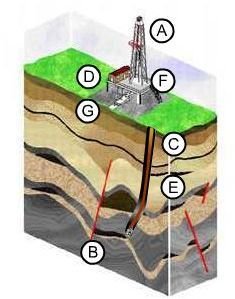
Rotary drilling rig is made up of:
A. Hoisting equipment
B. Drilling bit
C. Drill pipe
D. Rotary equipment
E. Mud circulating treating equipment
F. Blowout prevention system
G. Power source
Drilling Rig
Three important factors involved in successful rotary drilling process are, the weight exerted by the drilling bit on the rock, its rotation and the removal of the cutting debris using a circulating fluid (drilling mud). Drilling is a round-the-clock operation. A drilling supervisor leads a team of experts who work in shifts. Wells are usually drilled vertically but can be drilled at an angle also. This technique, called directional drilling, is used for a variety of reasons. A major advancement in oil and gas discovery is horizontal drilling, which drills along a reservoir horizontally and increases production.
Next article deals with onshore drilling and as well as offshore drilling process and equipments in detail.
>>Next article: Drilling for Oil: Onshore and Offshore Drilling
Related Articles:
Exploration and Production of Hydrocarbons – Seismic Surveying
Exploration and Production of Hydrocarbons – Big Picture First
Drilling for Oil: Onshore and Offshore Drilling
References:
IFP Publications
This post is part of the series: Exploration and Production of Hydrocarbons
The influence of fossil fuels can never be overemphasized on human civilization. From power plants to automobiles, lubricants to paints and synthetic yarns to cosmetics, petroleum products are used everywhere. A journey of oil and natural gas industry, from exploration to production of Hydrocarbons.