If combustion in a boiler takes place with oxygen instead of air, the resulting product is pure CO2 that can be directly sent to storage. How does this system of combustion work? What are its advantages and/or problems?
Reducing CO2 emissions, at the same time keeping the capture costs down, is the prime requirement of any Carbon Capture and Storage System.
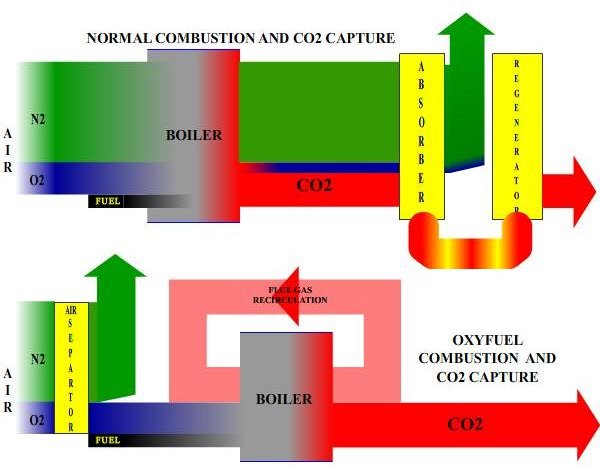
The normal combustion of fossil fuel takes place with air. This results in a flue gas that has around 12% of CO2. To capture this CO2 we have to handle the entirety of the flue gas that is eight times more than the mass of the CO2. Handling facilities, chemical requirements, and parasitic power are all high because of this.
One method proposed is to have the combustion occur with oxygen instead of air. The result is a flue gas that is almost purely CO2. This can go directly to storage after removal of other emissions like SO2. This eliminates the big and costly process of separating CO2 from a very large volume of flue gas.
Separation of Oxygen
First, we have to get pure oxygen for combustion. The cheapest and the best source of oxygen is air. A 1,000 MW power plant will require around of 250 tons of oxygen per hour. Cryogenic Air Separation Units are the ones that can produce this large quantity of oxygen. Even though this is a proven technology, it is a very energy intensive process.
Heat transfer
The second issue relates to heat transfer. The boiler heat transfer surface design depends on the mass of hot gases that flow over it. In normal combustion, the volume of gases is eight times that of CO2. If we fire only oxygen, then the mass of flue gases is much less. This requires a massive increase in heat transfer surface areas. This is not economical or practical. The only way to get over this is to re-circulate the CO2 only flue gas through the heat transfer surfaces. This again is an energy intensive work that requires hot flue gas recirculation fans. .
Flue gas recirculation is a widely used and proven technology in multi-fuel-fired boilers.
Combustion
The third item relates to the combustion. With oxygen only combustion, the flame intensities are very high. This will require a redesign of the burners and other heat transfer equipment. They should withstand high temperatures.
Retrofitting this to an existing plant may be not that easy. For newer plants after considering overall costs and benefits including CO2 capture, OxyFuel combustion may be feasible.
This post is part of the series: Carbon Capture and Storage Systems.
Reducing CO2 emissions is the need of the day. To continue using Fossil Fuel energy, but with reduced CO2 emissions, the only way is to capture it and store it. So enters the Carbon Capture and Storage Systems (CCSS). How to capture it? How to store it? What is the status?