Swath vessels consists of a peculiar type of hull design that reduces the contact of the ship’s hull with that of water, making the ship faster and more stable. Find out more about the swath vessels.
Introduction
One of the main reasons that act against the speed of a ship is the resistance of the ship’s hull against the water. Reducing the contact of ship’s hull with that of sea water also reduces the friction, allowing the ship to travel faster. SWATH technology, also known as the Small Waterplane Area Twin Hull, is one such method for increasing the speed of the vessel my reducing the craft’s contact with vessel.
Design and Construction
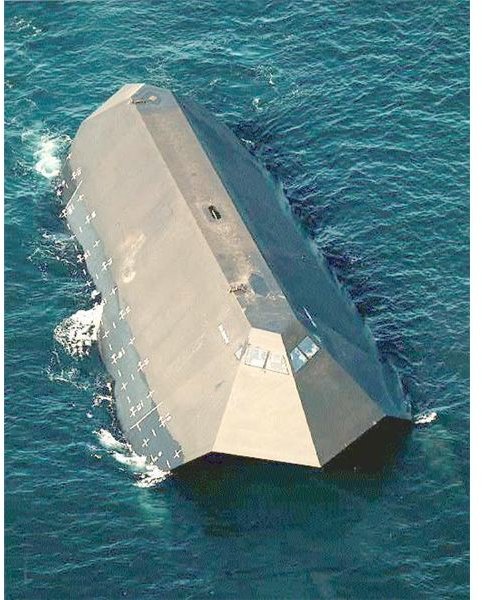
Unlike the conventional hull, which rides on the water surface, the hull of the Swath vessel is fully submerged inside the water. However, that doesn’t mean that the area of hull in contact with the water is more. The peculiar shape of SWATH is such that its hull, which has a very less area, remains completely submerged in water, whereas the deck rides high above the water surface, thus providing higher speed with excellent stability to the craft.
The water plane of a ship is that part that actually cuts the water as the ship moves forward. The trick for minimizing friction is to reduce the surface area of the water plane by keeping it as small as possible. This allows the vessel to have high stability even in the roughest weather condition.
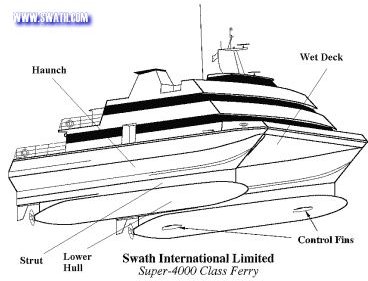
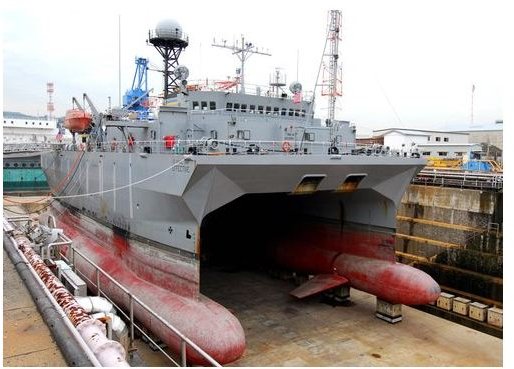
Swath vessel consists of two submarine shaped hulls attached to its bottom area. The shape of a Swath vessel resembles that of a catamaran. The two submarine shaped hulls are attached to the vessel using a thin structure or struts. The main aim of the entire design is to keep the volume of that part of the boat which is inside the sea water and has the highest wave energy acting, the least.
Additional Design Aspects
It is to note that during the construction process, if the contact area of the strut with the water is decreased, the transverse area between the two hulls should be increased in order to acquire appropriate transverse stability to resist the heeling movement. Also, smaller struts will provide less space for machinery inside the craft and also make the lower hulls less accessible. Thus, it is very important to choose the right water plane area for the overall performance of Swath Vessel.
Also, in order to smoothly ride over the small waves in coastal areas, the clearance underside of the Swath vessel should be adequate. This particular movement of Swath, which involves small vertical motions, is called platforming.
Thus, Swath technology is an efficient way of cruising at higher speed than those of the conventional crafts without sacrificing the necessary stability. Presently, apart from the military use, Swath Technology is being used for small passenger ferries and cruise vessels.
References and Image Credits
https://www.murdoconline.net/2007/usns _effective_drydock-thumb.jpg
https://www.swath.com/images/designs/diagram1.gif
https://www.swath.com/History/seashad.jpg