If you have seen a ship from a nearby distance, you will not miss the peculiar marks on the side of the ship which are known as load line marks. But do you really understand the meaning of these load-line marks?
Introduction
In the previous article we learnt a few terms related to ship floatation apart from Archimedes Principle. In this article we will proceed to learn something about the load line markings which seem like strange lines engraved on the ship side but actually have a very significant meaning.
Plimsoll - Load Line
Who was Samuel Plimsoll?
Samuel Plimsoll was the name of a nineteenth century British politician but then you might ask what has that to do with load line markings of a ship? Well let me tell you that it was this gentleman who played a vital role in establishing strict regulations regarding loading of ships in a safe manner and hence the load line is also as the Plimsoll line to honour him.
Reading the Load Line
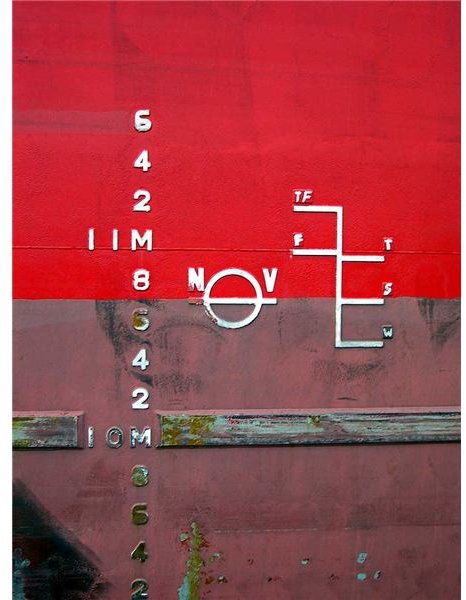
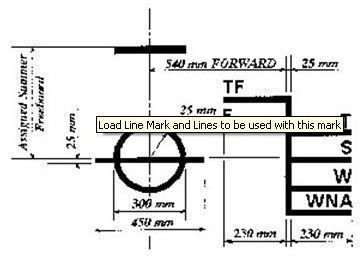
At the end of this article you will see two images, one of which shows a graphical sketch of the load line marks while the other is a real picture taken from the side of a ship. The various markings on the images have the following meaning.
Deck Line – this is the line shown on top which is 300 mm long and 25 mm thick (infact all lines are of equal thickness of 25mm) and it denotes the level of the freeboard deck.
The circular symbol with a line passing through it in the middle is directly below the deck line.
Summer Load Line – this is the line marked “S” and is in line with the center of the disc. It denotes the depth to which the ship can be loaded when it is floating in salt water in the summer zone.
Fresh Water Load Line – this is the line upto which the ship can be loaded in fresh water in the summer zone. It must be noted that when a ship loaded to “F” in fresh water goes into salt water it automatically comes to the “S” level.
W and WNA refer to Winter and Winter North Atlantic lines respectively for loading in winter zone
TF and T refer to the tropical fresh water line and tropical fresh water line respectively
Load Line Images
Reference
Images of Load Line - Maritime & Coastguard Agency, UK, Statutory Instruments 1998 No. 2241, The Merchant Shipping (Load Line) Regulations 1998