A ship is to an ocean like a car is to the road. Of course there are several differences between the two except that they are both modes of transport in different mediums namely land and sea. Learn about bulkers and how they are used in marine trade
Introduction
We have been studying about various types of commercial ships are used to transport dry unpackaged goods (of course there are other types of cargoes as well) over large distances through the medium of the oceans and the types of sailing ships which carry such cargo are classified as bulk carriers ships. This cargo could be food-grains, coal, wood, cement, ore and so forth.
Bulk Carriers
The strict technical definition of a bulk carrier has been adopted by the International Convention for Safety of Life at Sea (SOLAS ) and it defines a bulk carrier as a ship which has a “single deck, top side tanks and hopper side tanks in cargo spaces and intended to primarily carry dry cargo in bulk; an ore carrier; or a combination carrier”. Most of the classification societies do not follow this definition strictly but have their own broader version of the same. But if you are confused about this definition business do not worry; you can simply assume safety that any ship carrying “solid” cargo is a bulk carrier. Of course as you know there are always exceptions to rules and there are a special category of ships known as OBOs or Oil Bulk Ore carriers which can carry both solid as well as wet (liquid) cargo depending of the requirements.
Sub-Classification of Bulk Carriers
Bulk carriers are a class of ships but even they can be further subdivided into various types.
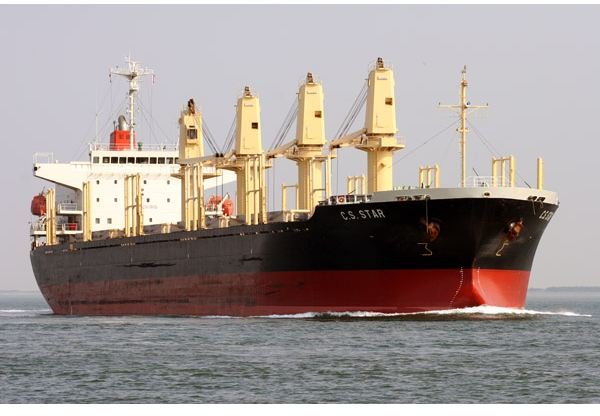
Geared Carriers - the ship shown in the figure below is known as a geared carrier which means that it has got its own gear (or equipment) to load or unload cargo. This gear is in the form of cranes or derricks. In the given picture you can clearly see four cranes in yellow colour between the cargo hatches.
Gearless Carriers - Some ships do away with the cranes and derricks but depend on the equipment available at shore to load/discharge cargo and these are known as gearless carriers. Obviously the utility of such a ship is greatly dependent on the equipment available at shore, so they may not be able to go at all the ports which do not have such facilities and depend on the ships equipment for loading/unloading of cargo.
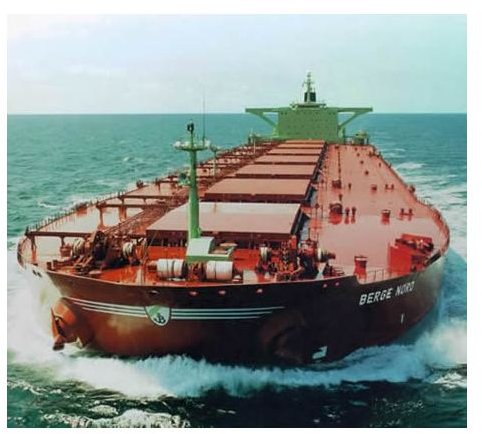
Bulk carriers can also be divided on the basis of their cargo carrying capacity.
Mini bulk carriers or MBCs are relatively small bulk carriers usually have capacity between 500 – 2500 tons and are used typically used for coastal trading.
The other types of bulk carriers in the increasing order of the cargo carrying capacity are
- handysize carriers
- handymax carriers
- panamax carriers
- capesize carriers
- very large bulk carriers.
We will learn more about bulk carriers and their various aspects in later articles but as of now we will proceed to talk about tankers in our next article
Image Credits
www.ships-info