The crankshaft of the marine diesel engine is a huge bulky component which should remain as straight as possible during operation, otherwise it could lead to serious damage to the engine and the vessel. Learn about deflection in a crankshaft and how to keep the alignment within limits.
Introduction
In the previous article we studied about marine diesel engine crankshafts in terms of their construction, materials and so on. In this article we will proceed to learn about one very important task related to marine diesel engine crankshafts and that is learning to take their deflections. In the succeeding paragraphs you will learn about the importance and procedure of the same.
The Need to Measure Deflection
If you remember about the construction of the crankshaft from the previous article, you will recall that apart from other parts, it consists of crank-webs, crank-pins and journals along its length. The weight of the crankshaft is supported by the main bearings at the journals. Over a period of time as the engine keeps running, the wear in the bearings may not be uniform across the entire length of the crankshaft. This means that the crankshaft will not remain in the initial straight line but will get bent either upward or downwards to a slight degree which may not be visible with the naked eye but could be sufficient to cause dangerous levels of fatigue in the crank-webs. Hence there is the requirement of measuring crankshaft deflections at regular intervals to ensure that the alignment of the shaft is within permitted limits and these deflections can be measured as described in the next section.
How to take Crankshaft Deflections?
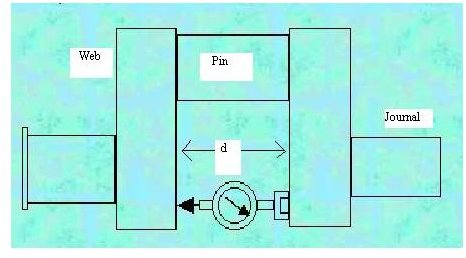
The figure shown below gives an idea of which measurement is taken to find the deflections of the crankshaft. As you can see from the picture a dial gauge is inserted between the crank-webs to find out the distance between them. If the deflection is measured after the specified interval, it is necessary that it is taken at the same point otherwise the reading will not give a real reflection about the degree of deflection. Normally a center punch is used to make markings so that each time the deflection is taken at the same point.
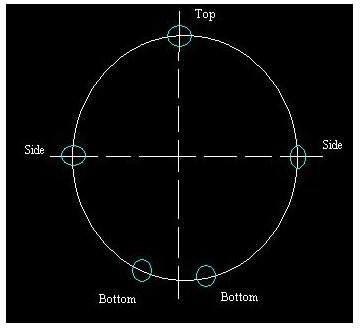
Apart from using the same point on the crank-web for measuring deflection there are other factors which need to be kept in mind and these include load on the ship, trim, hog, sag etc. Ideally the deflection needs to be taken at four points of the crank namely top, bottom and the two sides. In actual practice however the bottom reading is not taken due to chances of fouling by the connecting rod and instead reading is taken on both sides of the bottom position, thereby in total 5 readings are taken from each crank-web at the positions shown by the following figure.
We will learn more about recording, presenting and interpretation of the results in the next article .
References
Image of Dial Gauge in CrankWeb - Marine Engineering Knowledge by Brian