India has twice become victim of the dumping of scrap radioactive materials like depleted uranium coming in with scrap metal for recycling. This article will discuss the possible and reasonably safe uses of depleted uranium or DU.
What is Depleted Uranium?
Depleted uranium, in simplest terms, is the less radioactive form of uranium . How much less radioactive? Around 60% less radioactive.
In a little more detail, natural uranium consists of roughly 99.27 % U-238 and the rest is U-235 and U-234. Depleted uranium, on the other hand, consists of around 99.60% U-238. The U-238, U-235 and U-234 are the different isotopes of uranium, out of which U-235 and U-234 emit dangerous beta and gamma radiations and the U-238 emits relatively safe alpha radiations. The alpha radiation is safer because it cannot penetrate human skin.
As DU consists of less than 0.4% of U-234 and U-235, it is radioactively safer.
Properties of Depleted Uranium
- Mildly radioactive material.
- Density of DU is very high, around 19 gm/cc, which is more than 1.5 times denser than lead. It is around 15% less dense than world’s most dense material, iridium.
- The depleted uranium is pyrophoric in nature, meaning the powder of DU can easily catch fire in the presence of humid air.
- DU has a half-life of around 4.5 billion years.
- Like other heavy materials, depleted uranium is also poisonous if inhaled or taken with foods.
Usage of Depleted Uranium
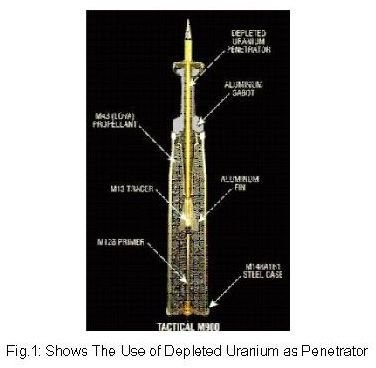
- Kinetic Energy Penetrator: Because depleted uranium (DU) is very dense, it is possible to make a thin but strong and sharp Penetrator out of it. Moreover, DU has a self-sharpening property. This means that if a DU Penetrator hits some hard materials, it partially fractured in such a fashion that the remaining portion remains sharp. This gives the DU Penetrator the power to pierce the strongest armor.
Additionally, the pyrophoric nature of DU causes the easy explosion of the enemy vehicle once the Penetrator enters into the vehicle.
Shielding Applications: With suitable protection layers, DU is used for shielding the equipment or applications causing the gamma and beta rays. This is possible because of its high density. However, the radiation and contamination from the DU itself need to be taken care of suitably by using stainless steel or thermoplastic material of adequate thickness.
Defense Armor: DU sandwiched between stainless steel plates is used sometimes for tank armor. The high density of the material makes it a good choice for this purpose.
Nuclear Weapon: The depleted uranium is used as a tamper for nuclear weapons. The tamper is used to reduce the expansion and thus increase efficiency.
Re-Enrichment: U-235 and U-234 are very precious. DU contains a low amount of them, so it is obvious that some country like the US may want to re-enrich the DU to make it suitable for use in a nuclear reactor.
Conclusion
The density, the pyrophoricity, and the self-sharpening property of the depleted uranium or DU make it a suitable material for armor, shielding, and penetrating applications. However, since it is a mildly radioactive and fairly poisonous material, factors like enclosure design and contamination of nature need to be analyzed very seriously before considering using depleted uranium for any application.
Reference:
Wikipedia - Depleted Uranium