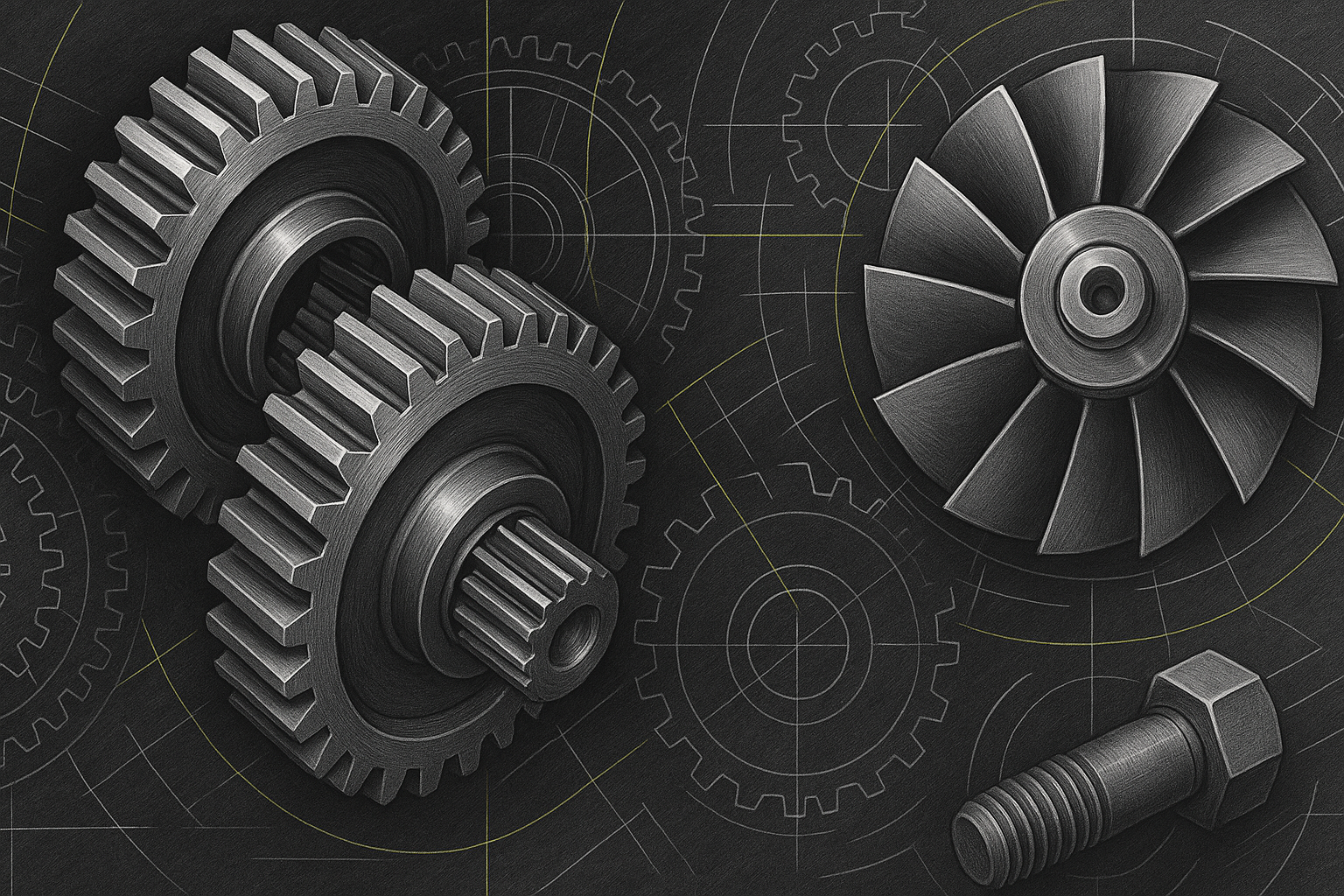
Nickel-Steel alloy is a very important material. It is used for making different products such as, gears, bolts etc.
Introduction
A steel casting is considered to be an alloy steel casting if the alloying elements, either residual or added, are present in percentages greater than the following:
Mn 1.0%, Si 0.70%, Ca 0.25%, Mo 0.10%, V 0.05%, W 0.05%, Al 0.05%, Ti 0.05%, Cu 0.6%, Ni 0.4%.
Limitations on sulfur and phosphorous contents apply to cast alloy steel as well as to cast iron steel unless they are specified for the purpose of producing an alloy effect.
According to the above combinations of alloying elements, alloy steels are called many names like chromium steels, cobalt steel, high speed steel, manganese steel, molybdenum steel, nickel steel, silicon steels, stainless, steel, tool steels, tungsten steels, vanadium steels, and so on.
Nickel-Steel Alloy
Nickel-Steel alloy is the most important among all the steel alloys due to its use in various places all around the world. It is formed when some percentage of nickel is added to the steel. It has a content of carbon too. It contains 0.35% carbon and 3.5% nickel in its composition.
The addition of nickel to structural steel results in an increase of strength without a proportionality great decrease of ductility.
Effect of alloying nickel to steel
- Effect on Toughness
When nickel is added to steel as an alloy, the nickel component increases the toughness of steel. Due to the increase in toughness, the property of steel to resist fracture due to high impact increases. This property is beneficial in parts made of steel subjected to shock and impact load.
- Effect on distortion
The addition of nickel in steel decreases the value of distortion (distortion energy) at the time of quenching.
- Effect on Critical Temperature
The critical temperature of steel decreases when nickel is added to it. Due to decrease in critical temperature, steel becomes better for any type of heat treatment.
- Effect on Strength
The strength of steel increases because of alloying nickel in the steel. Strength is an ability of material to resist the externally applied forces without breaking or yielding. Hence, steel can resist external forces much better.
- Effect on ability of uniting with carbon
The main disadvantage of nickel steel alloy is that it does not unite with carbon any more.
- Effect on Corrosion
The nickel steel alloy has more corrosion as compared to steel. The use of nickel increases corrosion in steel.
- Effect on Abrasive Resistance
The abrasive resistance of steel increases when nickel is added to it as an alloy.
- Effect on Elastic Limit
Nickel increases the elastic limit of steel.
Uses of Nickel Steel Alloy
Nickel steel alloy is used for making storage cylinders for liquefied gases and for other low temperature applications.
Nickel steel alloy is used for heavy forgings, turbine blades, highly stressed screws, bolts, and nuts.
It is used for making shafts, gears, propeller shafts, and keys.
It is widely used in combination with chromium and molybdenum for cams, chain pins, springs, connecting rods and their bolts, crankshafts, rolling element, and bearings.
Reference
Image: www.kaysuns.com - Componet made up of nickel-steel alloy