Nitriding is a thermochemical process that gives greater hardness to the surface of parts, providing greater resistance to external fatigue and friction.
What is Nitriding?
Certain parts that work in permanent friction risk wear and present ruptures with ease. This is the case, for example, of the crankshaft, the cylinder liners, pins and rotors, which must have high wear resistance at relatively high temperature. The piece can acquire this level of resistance through the technique called Nitriding.
Nitriding is indicated to obtain parts with higher surface hardness, to increase the resistance against wear, fatigue, corrosion, and heat. Steels that best lend themselves to this treatment are nitralloy steels, which are steels that contain chromium, molybdenum, aluminum and some nickel. In general, the nitriding is made after hardening and tempering. Thus, the nitrated parts do not need any further heat treatment, which contributes to a low level of distortion or warping.
Nitriding can be performed by gas or salt bath methods.
The Gas Method
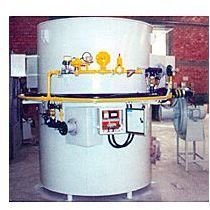
The suitable temperature for the job is from 500 º C to 530 ° C, and its duration varies from forty to ninety hours. At this temperature, ammonia (NH3) is decomposed, and nitrogen in the surface layer of the part reaches a depth from 0.15mm up to 0.80 mm.
The layer of metal surface turns into nitrites of iron, chromium, molybdenum, nickel, and the nitrites have high hardness.
After the heating time in the oven, the pieces are removed and cooled the air.
Salt Bath Nitriding
Nitriding can also be performed in a liquid environment. In this case, the parts are dipped in a bath of molten salts, which are the sources of nitrogen. The process is faster than the previous: the pieces remain in the bath only two or three hours at a temperatures ranging from 500 º C to 580 º C.
Carbonitriding
This process consists of introducing carbon and nitrogen in the steel surface. The process can be carried out in furnaces or salt baths controlled atmosphere (gas) and after it the surface of the carbonitrited layer acquires hardness and wear resistance. The process temperature ranges from 705 º C to 900 º C, with a duration of two hours. After that time, the pieces are cooled in water or oil. Using this method is possible get a layer with thickness from 0.07 to 0.7 mm.