Broaching is one of the most precise and productive process in the metalworking area and despite the high costs of broachs, its largelly applied in the automobiles industry. This article is the part 1 of the Broaching series, in a total of 3 articles.
A brief introduction
Broaching is one of the most precise and productive process in the metalworking area and despite the high costs of tooling, its largelly applied in the automobiles industry. The broaching is a machinining operation which uses a tool called broach moving it over the workpiece to remove material, cutting a predetermined shape.
Commonly circular or odd shapes, both internal or external, are obtained by broaching.
Internal shape obtained by internal broaching
The price per piece of broaching is very low because of its high production and low cycles, many times dispensing milling operations and it requires no skilled labor. The quality is often best than other combined cutting process.
When to use broaching?
The broaching operation is best employed in high volume workpieces: a customized broach usually costs between $8,000 (smallest ones) to $40,000 (bigger ones). The complete cycle hardly is over than 20 seconds, with great productivity and quality.
Many operations can be replaced by broaching, earning lots of time and requiring less tools. Almost any mettalic alloys can be broached, but this operation works best on soft materials like aluminum, copper alloys, brass and even in plastics, other polimeres and wood, with good performance on mid steels. Hard materials like titanium can be broached, but the broach will dull quickly.
Broach principles
The broach is a multi edge tool, with a progressive and linear cutting edges (so the broaching operations ever finish the surface in a single pass). For reference, there are cilindrical broachs for internal cutting by compression and plain broachs for external cutting by traction, but broachs can be build and categorized by many means.
Most broachs are made of uncoated HSS (High Speed Steel) and (less frequently) tungsten carbide. When coats are used to extend life and increase superficial hardness, TiN and TiCN are common chooses.
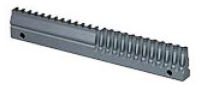
Plain broach coated with TiCN
Broaching machines
Broaching machines are very simple compared to other manufacturing machines as they only have to move the broach in a linear motion at a regular speed.They can be horizontal or vertical, but the vertical models are far more popular, because it saves more space than horizontal models.
Virtually all broaching machines are hydraulic but a few special cases are mechanically driven.
This post is part of the series: Broaching
Broaching is one of the most precise and productive process in the metalworking area and despite the high costs of broachs, its largelly applied in the automobiles industry.