Whenever I mention the word “welding” mostly you must be reminded of a person wearing thick gloves, a dark shield and holding some rod in his/her hand and rays, sparks and smoke flying all over. Well this picture has changed a lot over the years so learn how robots fit into this scenario!!
Welding is a process of joining together materials through the use of heat and/or pressure and there are various techniques of carrying out this process. Technology has advanced quite fast during the past few decades and even the techniques of welding have seen lot of improvements and innovations. As we know one of the greatest achievements of the current technological age is the invention of robots which are machines capable of imitating human actions and tasks, of course only to very limited extents.
One of the main uses of robots is NOT to make people lazy by replacing them for intelligent machines, but to increase efficiency, productivity and most importantly safety in the manufacturing processes. Since we know that welding is a pretty tricky business in the sense that it is always associated with heat, flames, smoke and radiation, it was certainly thought a good idea to use robots for the same.
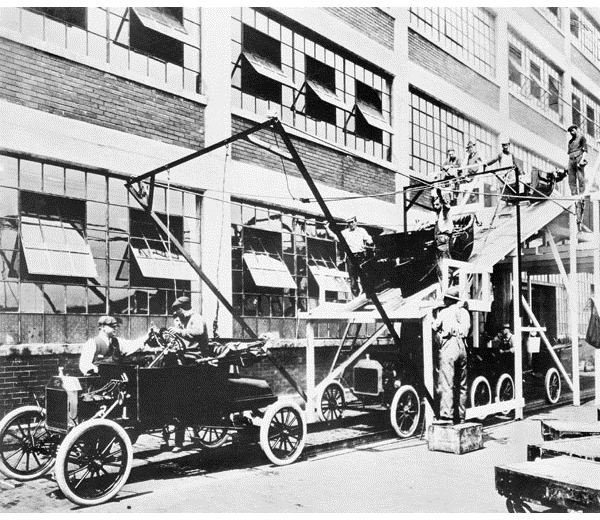
This is how robot welding came into existence nearly quarter of a century ago and currently is used in a variety of places in the engineering industry. To take an example from everyday life just check out with the manufacturer how the car which you use daily was manufactured in an assembly line technique using robots which consisted of long spider like arms quickly moving to and fro, joining parts here and there.
But although the process looks quite glorified, and it is actually so, it is not easy for “blind” machines to see where parts are placed and how the weld is actually taking place. Hence the overall robot welding process consists of accurately placing parts to be welded in predefined positions which are then fed into the computer which controls the robots. The position can be identified using coordinates so that the starting position, finishing position, timing of starting of the weld and timing of finishing can be accurately controlled.
Just imagine what would happen if there was no material in place and the robot just kept welding in thin air or if something else got placed in the position of the weld and got welded improperly. Hence this would appraise you of the need for accuracy in the welding process without which the productivity might decrease instead of increasing.
Robots are quite versatile (mainly because of the fact that they do not grumble and complain about overwork) and hence can be used for a variety of welding types such as resistance welding and arc welding. But even then a lot of complementary electronics is required to make these machines makes the right weld, in the right manner, at the right place, at the right time. After all we may not realize this, but to imitate the robot which nature has made so beautifully – The Human Body – is not something which can be copied easily. Hence this would certainly make you feel proud even if you do not know how to hold the welding electrode, let alone make a weld.
Read more about welding:
Safety First is a Must: Issues in Arc Welding