How about chucking the IC engine altogether and try to use another engine altogether? How would you like an engine that produces electricity that can be used to run your car and use any fuel to run this engine? have you heard of the nifty Free Piston Linear Alternator? read on to know more.
Even though our present day Hybrid vehciles seem to be able to operate on multiple fuels, there has always been a gasoline motor attached to these futuristic engine models either as an auxiliary power source or as a back-up. However, Researchers in China have now devised an engine that could run on any fuel and have just one moving part within in.
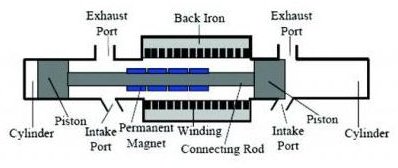
The ACS’ Energy and Fuels journal is going to feature a new device called as an FPLA (Free Piston Linear Alternator) and this is going to be an engine that could run with any fuel – including hydrogen or any other fuel you can possibly think of. A cross sectional diagram of the engine is as shown below for your reference (courtesy science daily – Qingfeng Li).
The engine consists of two cylinders end-to-end and has a double-headed piston (two pistons end-to-end corresponding to each of these cylinders) within the engine. The connecting rod between the two piston skirts passes reciprocates through the centre part of the engine where coils of an alternator and a permanent magnet are affixed. So each time the pistons shuttle between one cylinder to the other, the connecting rod makes a moves and produces electricity through the set-up at the middle of the engine.
As you can see, there is just the piston that moves here and nothing else. Of course, there might be a necessity to move the valves that have to time the Inlet and exhaust valves that adjoin each of the cylinders, but that is too minimal to take note of.
A computer model is being created to better study the possibility of this engine and see if it can truly satiate our quest for finding some form of commercially feasible alternative for our hybrid vehicles. This computer model is expected to evaluate the performance of the FPLA and guide the engineers towards a complete development of this prototype.
If all goes well for the FPLA, we have a new kid on the block with 3 times more accelerating vigor and just as much lesser polluting characteristics than the Internal Combustion Engine.