This article is the third in series for sound measurements which deals mainly with sound power measurements. This article will help us to understand more about sound power measurements and its advantages.
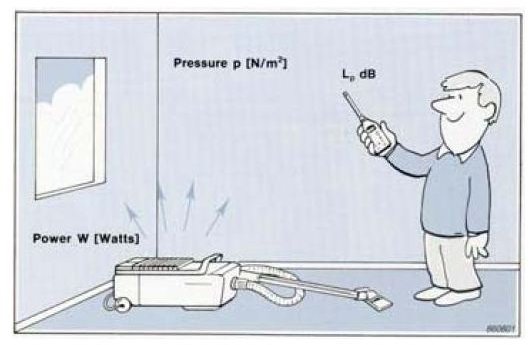
Sound power can be defined as the total sound energy emitted from a device. It is usually expressed in Watts (W). The sound power measurements do not have specific equipments for measurements but rely upon sound pressure and sound intensity measurements to arrive upon the value of sound power measurements.
Any sound source radiates power resulting in the creation of sound pressure. We can say that sound power is the cause for which sound pressure is the effect. This can be explained as follows by an example. Electrical devices say a motor converts the electrical energy into mechanical energy. The mechanical power generated by the motor is totally dependent on the electrical energy. It is in the same way the sound pressure generated is dependant on the sound power.
The normal convention of rating any device that moves, rotates or produces any motion is in the term ‘Watts’. Hence the same has been applied to Sound power measurements since “Watts” is a universal terminology.
Why is Sound power so important?
- All regulatory compliances specify the sound power levels for any home used equipments
- This helps to understand the characteristics of the device in a better way.
- The sound power value tends to give a better estimation value of the influence of noise on the surrounding environment
- This is one term where competitive manufacturing industries like automobiles can use to prove the competency level of their product.
Advantages of calculating sound power levels from Sound pressure measurements:
- Sound pressure is quite easy to measure requiring no expertise.
- The instrumentation is readily available and is quite cheaper.
- More number of international standards are available for converting sound pressure measurements to sound power levels
Advantages of calculating sound power levels from Sound Intensity Measurements:
- The measurements can be carried out in site eliminating the requirement of special chambers or rooms for making measurements
- The effect of continuous background noise need not be considered while sound intensity measurements are made for calculating the sound power.
- Has the advantage of the measurements to be carried out in far field as well as near field.
This post is part of the series: Sound Intensity Measurement / Measurment of Sound Intensity
Sound Intensity Measurement / Measurment of Sound Intensity