Were You ever curious to know where the concept of the automobile engine came from? Who conceptualized it? How did you think the very first engine model looked like? It was certainly not the way it is today. Curious to know more about the very engine model every created? Check the Huygen’s Model Out
We almost take our Internal Combustion Engines (the Automobile engines) for granted don’t we? All we do is buy our vehicles, hop in and drive around. There is, however, a history of development to know about. The compact, well-toned, powerful and surprisingly quiet engine that seems to be purr under your vehicle’s hood just wasn’t the tame beast it seems to be now. It was loud, it used to roar and it used to be rather bulky. In fact, one of the very first engines that had been conceived wasn’t even like the engine we know so well of today.
The Huygens Gun - powder Engine (1680)
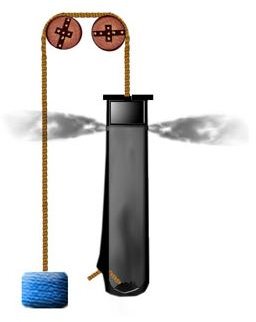
The automobile engine’s history has been well-documented and the conception and design of one of the earliest Internal Combustion engines can be attributed to a famous Dutch physicist Christian Huygens (1629 - 1695) in the year 1680.The figure below shows how the engine used to look like ( courtesy library.thinkquest.org)
It consisted of a vertical Cylinder having a sliding fit type of a piston. Explosion of a charge of gunpowder in the cylinder drove the piston on its upward stroke and then the return stroke was caused by the atmospheric pressure acting on the piston and also arising from the drop of the pressure in the cylinder due to the gaseous products of the explosion beginning to cool. The power that could be drawn form this engine could be attained from the downward stroke of the piston and by an arrangement of ropes and pulleys, which was applied to raise a loaded platform ( the concept of load the engine has to work on, those days).
This engine could not be developed into a commercial model due to the inherent fault of the way the explosion was to happen. There was no way to deliver the sequence of charges necessary for a continuous operation of this engine and also for controlling the rate of explosion within the cylinder.
The idea, however, led to a flurry of activity and people starting thinking in a directly which slowly paved way for our modern day automotive engine. Incidentally, it was Papin, a student of Huygen’s who finally built one of the earliest models of a steam engine.