Assembly tolerance chain stack up analysis is the secret of designing a good assembly. This tolerance stack tutorial will explain how to perform tolerance chain stack up analysis by the root square sum or RSS method.
There are many methods and tools available for performing assembly tolerance stack up analysis. I already have an article on worst case method assembly tolerance stack up analysis .
Though the worst case method is very simple to perform, it is only suitable when small numbers of components are in the assembly. Also, the worst case method assumes that all the components will fall in the extreme ends of the tolerance zone. That’s why you will get a wider tolerance zone for the assembly in the worst case method.
What is the RSS Method of Assembly Tolerance Chain Stack Up?
The root sum square (RSS) method works on a statistical approach. It assumes that most of the components fall to the mid of the tolerance zone rather than at the extreme ends. How do you really perform a RSS tolerance chain stack up ?
How to Perform Root Sum Square Assembly Tolerance Stack Up?
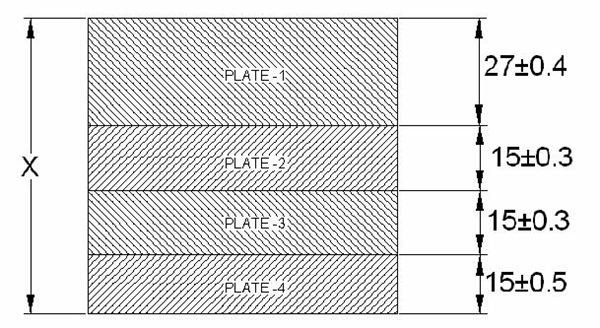
Let’s take the following assembly as an example:
The aim of the assembly tolerance stack up analysis is to find out the overall thickness of the assembly (X) with tolerance. We have the thickness and the tolerance values of all the plates (plate-1, 2, 3 and 4).
- Calculate the nominal thickness of the whole assembly as below:
X = 15 + 15 + 15 + 27 = 72
- Find the Standard Deviation (σ) of Each components tolerance as below:
σplate-1 = 0.4/3 = 0.133
σplate-2 = 0.3/3 = 0.1
σplate-1 = 0.3/3 = 0.1
σplate-1 = 0.5/3 = 0.167
- Find out the standard deviation of the tolerance zone of the assembly like below:
**σassembly = √ [(****σplate-1)^2 + (****σplate-2)^2 + (****σplate-3)^2 + (**σplate-4)^2 ]
= 0.256
- Find out the tolerance zone of the assembly like below:
T = σassembly * 3
= 0.256*3
= 0.768
- So, The thickness dimension (X) with the tolerance zone of the assembly will be:
X = 72 ± 0.768
Conclusion
The root sum square or RSS or statistical tolerance stack up method is useful for doing the assembly tolerance chain stack up analysis of an assembly with large numbers of components in it.
Related Reading
**GD&T Tutorial on Projected Tolerance :**This geometric dimensioning and tolerancing or GD&T tutorial will discuss projected tolerance and its application and benefits for preparing engineering drawings.
References
- Process Tolerancing: A Solution to the Dilemma of Worst-Case Versus Statistical Tolerancing - http://www.variation.com/techlib/ta-2full.html