As society has become more fast-paced, the need for a more efficient mode of transportation has arisen. One recent technology that meets this new demand is the maglev or magnetic levitation train. In this article, you will learn how magnetism is used to support and propel these trains.
In today’s fast-paced and technological society, efficiency is critical. One essential factor in our lives is transportation- traveling between our home and workplace and moving goods to marketplaces- to name a few examples. Consequently, other than airplanes, the conventional methods of transport such as cars, buses, and ships, are incomparable to more advanced transportation methods, such as maglev trains.
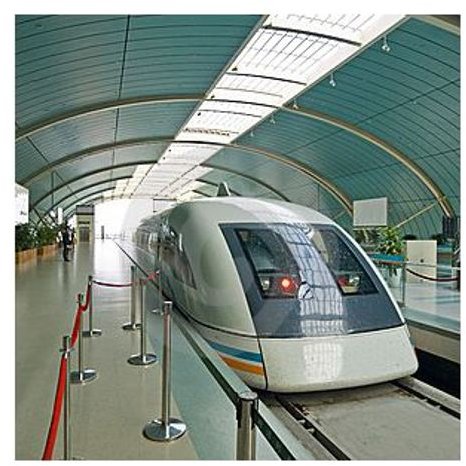
Maglev, which stands for magnetic levitation, is a system of transportation that levitates, guides, and propels trains, with magnetism. Electromagnets along the guide-way beams and magnets underneath the train allow for repulsions and attractions, which move the train along the track. Steel wheels and tracks are removed to create a frictionless ride, allowing for speeds above 500 km/h.
How Magnetic Fields are used
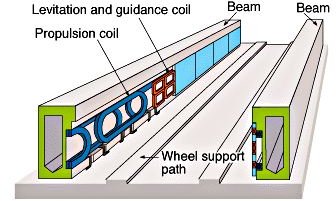
Specifically, only magnetic fields are relevant to the maglev train. Metal coils lining a guide-way become electromagnets when an electrical current runs through them, to begin the movement of the maglev train. The magnetic field created by this electromagnet is used to levitate the train 1-10 cm above the track by repelling the large magnets attached to the underside of the train. The beams on either side of the track also contain metal coils used for propulsion. Once the train begins to levitate, an electric current is supplied to these propulsion coils, which creates a combination of magnetic fields that push and pull the train along the track. The electric current in these coils constantly alternate to change to polarity of the electromagnets. This change in polarity causes the magnetic field in front of the train to pull it forward, while the magnetic field behind it adds more forward thrust. It is the lack of friction and the train’s aerodynamic design that allow for speeds over 500 km/h.
The Impact on Society
All can benefit from the maglev train, and especially those who travel regularly. The benefit extends to individuals, allowing people to reach their destinations quickly and efficiently. In addition, the benefit also extends to the country, by allowing for the employment of engineers in many countries around the world to perfect new construction methods, being a source of revenue for the country, and by reducing energy consumption, air pollution, and noise pollution.
Unfortunately, maglev trains have also had a negative impact on society. Due to its relatively recent invention, the maglev train’s potential issues are not completely known, and therefore two major accidents have occurred in the past two years. One was a train that caught on fire as a result of electric problems, in Shanghai. The second was in Germany, in which a collision with a repair car left on the track, killed most of 29 passengers. However, recent innovations to the design of the guide-way and the electrical conduction throughout the train have significantly reduced the number of accidents.
Ultimately, maglev trains have the potential to change the lives of people around the world, with unprecedented ground transportation speed.
Citations
Reference:
Image Courtesy: