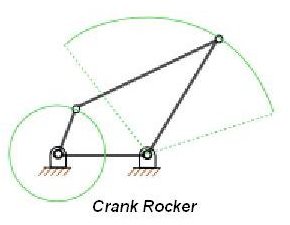
This article covers the basics of a crank rocker or crank slider four bar linkage and various applications used.
Rotational Motion
Most engineers are faced with the task of designing a machine or device that accomplishes a specific function. The easiest and simplest means of creating motion in a machine is to use a motor. Motors inherently provide only rotational motion. This forces the engineer to either live with this rotational motion or use specific designs in order to convert this rotational motion into linear or oscillating motion based on their application. For linear motion the general approach is to use a rack and pinion design, but for oscillating applications there are two specific designs that engineers use; the crank rocker or the crank slider.
Crank Rocker and Crank Slider
Oscillating Applications
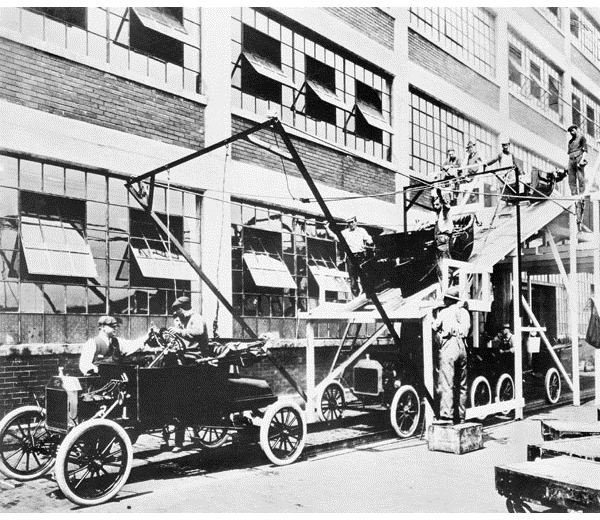
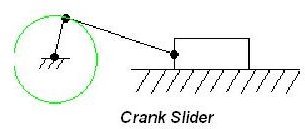
Various applications use the links shown above. The most common obvious one for the crank rocker in the automobile is the windshield wiper. The motor provides the crank and the wiper oscillates back and forth wiping water and debris from the wind shield. Similarly this same design is also used in infant’s cribs for rocking the cradle. Any application that requires a constant oscillation can have this design applied to it. The location of the links plays an important role on the angle that the rocker operates. Also the length of the links is another key factor. Adjusting these can result in a power stroke in one direction that uses more of the power from the motor while the returning stroke uses less power. Automation systems for various manufacturing facilities use this linkage to move goods and even assemble parts together with consistent repeatability. This is an important linkage design and a great tool to keep handy when developing an oscillating mechanism.
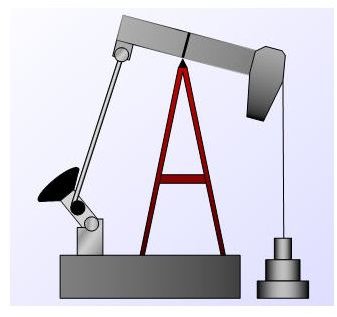
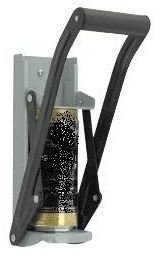
The crank slider is a similar design that allows the block to slide back and forth. This can be used for various applications. This design is used in the opposite manor inside automobile engines and even on steam engines. The slider is the cylinder where the explosion/high pressure occurs and the linear motion is converted to circular. This is a critical design that is used extensively in automation systems where products are pushed and moved on a production line. This device is perfect for feeding materials into a machine at a specific speed and consistent rate. Crank sliders are also used extensively on heavy construction machines, oil rigs/pumps, and even simple soda can crushing machines.
When designing a machine or mechanism and the task requires converting rotational motion to an oscillating motion, these designs should be the first to come to mind. Every application is specific and each design must be custom tailored to suite it’s needs, but the underlying basic design and function of these 4 bar linkages is the same.
Linkages Used Everywhere!