This article deals with the various types of preloading methods used for bearings. We will look mainly into the axial adjustment type of preloading of bearings in this article.
The first article in this series described what preload is. It is basically constraining the bearing axially in order to reduce the clearances in the bearing. Hence axial adjustment of the bearing by any means is another methodology for the preloading of the bearings.
We will look into detail on how we can axially restrain the bearings in order to get the preload we require in the bearings. The best feasible methods know to us for axially restraining a bearing are as follows
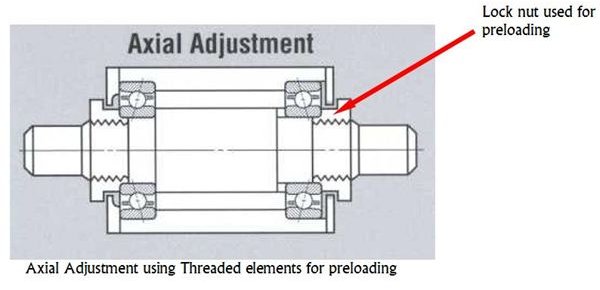
· Provision of threaded members in the assembly, which can be tightened to preload the bearing. Even if the preload reduces due to wear the threaded member can always be tightened to take care of the preload. The only precaution to be taken in this aspect is that the loosening of the threaded member should be prevented after tightening.
· Provision of shims is another method of inducing preload to the bearings. The shims are basically provided in the caps that hold the bearing outer races and axially restrain them from moving. The shims are normally very thin usually about 0.1mm to 0.2 mm thick. The shims are normally stacked up together up to 5 (Five) in a single case. As and when preloading of the bearing is required due to wear, the only thing the user needs to do is to remove either one or two of the shims which will make the cap to move in and preload the outer race of the bearing. The amount of movement of the cap axially will depend on the thickness of the shims removed.
· The other method of preloading the bearing is by means of providing spacers between the cap and the bearing and the outer race. This method is not preferred much due to the intricacy involved and requires great amount of expertise.
Though this method is really a good method, it does tend to have some disadvantages. They are
- The use of threaded members always tends to have out of squareness in the face of the nut and hence have the capability to induce misalignment in the bearing. Hence this has to be done with utmost care possible.
- The use of shims is a good methodology but requires good amount of experience and expertise to carry it out. Any mistake in this can lead to either excessive preloading or lesser preloading of the bearing.
We will look at the other modes of preloading of the bearings in the forthcoming articles.
This post is part of the series: Preloading of Bearings
This article deals with the preloading of bearings. Apart from the assembly of the bearing it is very important to preload a bearing for it proper working. We will look into the various methods of preloading of the bearing in this article.