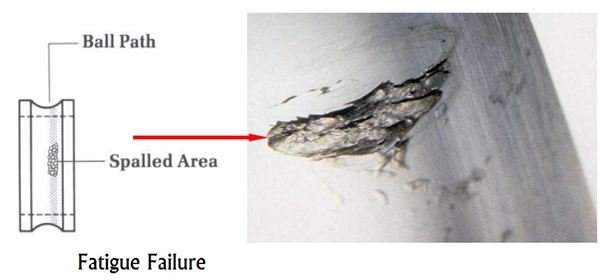
This article is the third in the series on failure modes in bearings. We will look into detail on the fatigue failure and Contamination failures in bearings. The means of identification and the possible remedies are also explained.
Fatigue Failure (Spalling) : This is also referred to as Spalling. This is caused due to the rupture of the contact surfaces.
· Causes: The rolling elements or the balls running on the raceways tend to create high contact stress. The rolling contact continuously stresses the complete raceways again and again and at a point the contact point in either the raceway surface or the ball surface tends to rupture unable to bear the stresses. This rupture does not remain as it is and tends to rupture further. This is caused due to the increased stress in the surrounding areas of rupture and this increases continuously until failure of the bearing. Further this normally happens after the desired life of the bearing ( L10 Life) for which it is intended to be used for. A good example for this is applicable in the aerospace applications where a bearing is compulsorily replaced once its reaches the L Life.
· Remedy: Any increase in the life of the bearing can be done so by selecting a bigger bearing which has a fatigue life higher than the currently used bearing.
We will now look into another important cause for the failure of the bearing. Any system properly safeguarded from extremes tends to survive easily. The same applies to bearings also. Preventing it from Contamination is something like that.
Contamination Failure: Of all the causes of failure in bearings, Contamination contributes to nearly 75% of failures. The contamination can be of any form from being
· Airborne like dust, dirt, abrasive particles, etc.
· Lubrication based like foreign particles in the lubricant, metal particles from within the system, etc.
The contaminants tend to scratch the fine surfaces of raceways and rolling elements leaving a very dull finish to them. Certain times based on the size of the contaminant they also leave dents on the bearing contact surfaces. These dents further develop themselves leading to failure.
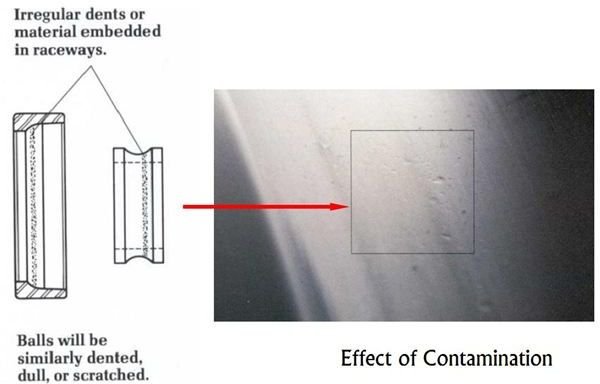
· Causes: Principal causes are unclean work areas where the bearings are mounted or assembled. Using of unauthorized or spurious lubricants can also lead to this type of failure.
· Remedy: Using clean and original lubricants. Assembling the bearings in a controlled atmosphere where dirt, etc., can be maintained to the minimum level possible.
We will look into the other types of the bearing failures in the next article.
This post is part of the series: Failure modes in Rolling Bearings
Bearings are normally designed and selected to last for a life time. Any failure occurring in it needs to be identified properly. This article will help you in determining the various causes and the type of failure the causes tend to induce on the bearing.