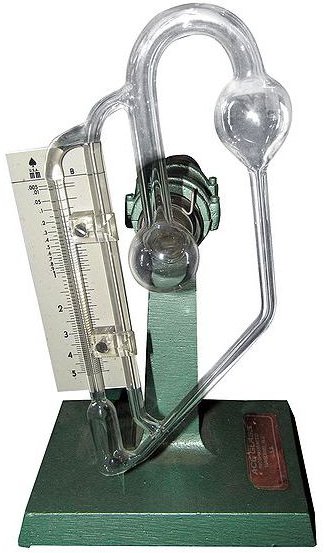
The McLeod gauge is used to take pressure measurements of vacuum chambers and to calibrate other gauges. Its principle of operation relies on Boyle’s Law, and so assumes an ideal gas. This is fine for incompressible gases, but is a drawback in typical vacuum operations.
Background
The McLeod gauge is a interesting little device that once enjoyed widespread use in measuring vacuums. Though the McLeod gauge is slowly being replaced by electronic gauges, it is still indispensable in certain situations. Interestingly, the McLeod gauge is able to measure very small pressures without any electronics or other high-tech equipment; instead, the working principle of the McLeod Gauge in vacuum measurement uses properties of mercury. Herbert McLeod invented the device in 1874 for use in his experiments. McLeod was a lecturer at the Royal College of Chemistry, and did work on anilinine dyes (helping to invent magenta dye in the process) and later invented a new type of aspirator.
Working Principle of the McLeod Gauge
Is the McLeod Gauge a type of manometer? Well, recall the definition of manometer: “an instrument for measuring the pressure of gases and vapor,” per Merriam Webster. The McLeod gauge’s purpose is to measure gas pressure at very small pressures, down to near vacuum. Thus, a McLeod gauge is indeed a manometer, albeit one specifically adapted for low pressure environments. The working principle of the McLeod gauge in vacuum is quite similar to a mercury column manometer. Though McLeod gauges usually use mercury, they may be designed to use other substances.
In order to take a pressure reading of a vacuum chamber, the McLeod gauge must take in a sample from the chamber. Caution during this operation is crucial, as errors could cause accidental release of the mercury into the test chamber. After the gauge takes in the sample volume of gas, it is tilted again such that the mercury applies pressure to the gas. A manometer then measures the pressure applied by the gas using movement of mercury in the manometer. Using the final pressure, final volume, and initial volume, the initial pressure can be calculated with the help of Boyle’s Law. Boyle’s law states that p1V1 = p2V2. The McLeod gauge calculates pressure in absolute terms, rather than relative (relative pressure is difference from atmospheric pressure).
Modern Uses of the McLeod Gauge
Compared to digital gauges, the McLeod gauge is somewhat unwieldy to use. Its use requires some calculation, and a liquid nitrogen bath may be required to prevent interference from the mercury’s vapor pressure. In addition, users must use care when operating a McLeod gauge, lest they accidentally release mercury.
Another issue is that the McLeod gauge is substantially less accurate for compressible gases than for incompressible ones. This is because Boyle’s law assumes an incompressible gas. For this reason, McLeod gauges should not be used for compressible gases like water vapor or ammonia. Use of a McLeod gauge with a compressible gas results in incorrectly low pressure measurements.
The McLeod gauge is, however, fairly accurate for incompressible gases. It is reliable for pressures from 10-2 to 10-7 torr (10-1 mm to 10-4 mm of mercury). Unlike digital gauges, the McLeod gauge has a constant calibration. The largest modern use of McLeod gauges is for calibration of digital gauges, such as Ionization gauges and the Pirani gauge.
Image Credit: Wikimedia Commons - McLeod Gauge 01
Sources
Tel Aviv University - Technique of High Vacuum , transcribed by Bruce Conover
Pneumatics, Department of Physics, Kenyan University - McLeod Gauge
HyVac Products, Inc. - HyVac McLeod Gauge Specs