How do your clothes keep you warm on a cold day? And why do rugs feel warmer to your feet than a tile floor that is at the same temperature? Could it be heat conduction at work?
A Simple Basic Equation
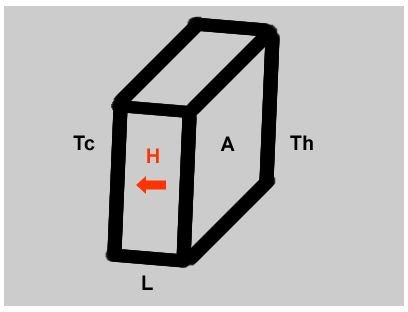
A simple equation to measure heat conduction is derived by considering a uniform slab of material with a thermal conductivity k, an area A, and a thickness or width L. The slab is heated so that transfer occurs from its hotter side to its cooler side. How quickly the transfer is made is dependent upon thickness of the slab, as well as the material it is made from.
The equation is
- H = -kA (ΔT/L) = -kA(Thot - Tcold)/L.
For SI units, H is in watts. The minus sign indicates that flow of heat is from a warmer object to a colder one.
Examples of Heat Transfer
Styrofoam is a good insulator because it traps pockets of air and other gases inside of it. Your fur or goose down coat keeps you warm in the winter because fur and feathers also trap air pockets. Wool and fiberglass also operate on this same principal, which is why wool socks are so effective, and why fiberglass is favored for insulating houses.
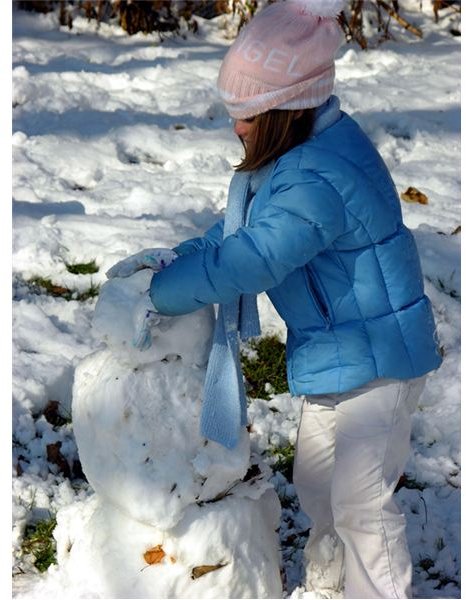
Clothes in general trap air pockets, and this is why they are such good insulators. In the winter, the trapped air helps keep you warm. If the air weren’t trapped, then it would move. The warm air that is heated by your body would leave to be replaced by colder air, and you would subsequently feel chilled.
Heat conduction also explains why a tile floor feels colder on bare feet than a rug or a wooden floor. The tile, wood, and rug are actually at the same temperature, but tile is a better conductor than either of them. It draws heat away from your foot more quickly than a wooden floor. The rug is even better, because it does not conduct heat away but rapidly warms up to the temperature of your foot.
What heat transfer process causes the water that you use to steam your vegetables to boil, or causes a radiator to heat your room? We will examine this in part three.
References
Conceptual Physics by Paul Hewitt
Essential University Physics by Paul Wolfson
Fundamentals of Physics by Halliday, Resnick, and Walker
Physics for Scientists and Engineers by Douglas Giancoli
Image Credits
Girl in down coat by Phaewilk
Resources
Video of A Heat Conduction Trick With A Water Balloon
Professor Julius Sumner Miller’s Heat Conduction Demos Video
This post is part of the series: Introduction to Heat Transfer
This is a series that describes the three methods of heat transfer. Parts one and two explain what heat transfer is, and the method of conduction. Part three discusses convection. In part four, thermal radiation is described.