Why do your popcorn kernels pop when you heat them? Why would you want to make a soda can implode? And why are people microwaving soap and putting the videos up on YouTube and other places on the Net? All soap microwavers may not know it, but they are demonstrating an application of Charles’ Law.
What is Charles’ Law?
Charles’ Law is the second of the gas laws. The first one is Boyle’s Law , which gives the relationship between volume and pressure. Charles’ Law is different in that it gives the relationship between volume and temperature in an ideal gas where the pressure is constant. If the volume increases, the temperature increases. Likewise if the temperature increases, so does the volume.
Charles’ Law is named after Jacques Charles (1746-1823), who discovered it but did not publish his findings. Mankind is able to benefit from his work due to the efforts of Joseph Gay-Lussac , who also used this result to fuel his own eponymous discovery.
The Equation
According to Charles’ Law, at constant pressure P,
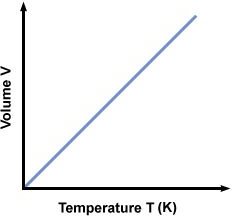
the volume V is directly proportional to the temperature T:
- V ˜ T
or
- V = kT, where k is a constant
Rewriting equation 2, we have:
- V/T = constant
Charles’ Law is also commonly written as:
- V1/T1 = V2/T2
where V1 and T1 are the original values of the gas, while V2 and T2 represent its final values.
In addition to the pressure being constant, the same caveats used in any ideal gas law apply here. These results apply for systems where an equilibruim state has been reached, the gas is not too dense, and P is around atmospheric pressure. Real gases approximate these conditions enough such that the law is applicable in every day life.
Microwaving Ivory Soap and Heating Popcorn
All soap is made with the use of water. Ivory soap is additionally manufactured with air deliberately pumped into it .
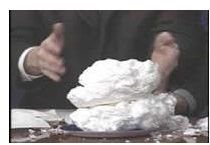
This is why this soap floats more easily than others when you place it into water. When you microwave Ivory soap for two to four minutes, depending on the microwave temperature, the air pockets become heated and then expand as the molecules move away from each other. Moreover, the water inside the soap turns into vapor that also expands. This combination produces the nice effect that you can see by visiting this link .
The amount of air in Ivory compared to other soaps is the reason why it is the premier choice to demonstrate soap microwaving. Other soaps tend to melt when placed inside a microwave.
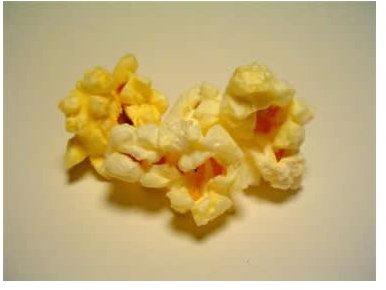
This is the same principle used when you heat your popcorn. The water trapped inside the kernels vaporizes and expands, causing the kernels to explode.
Imploding Soap Cans
Finally, microwaving Ivory soap is not the only experiment Charles’ Law aficionados like to engage in. The imploding can demonstration is also very popular on the Net. The video shown includes a neat demo of Boyle’s Law.
Image Credits:
V vs T graph from SparkNotes.com
Microwaving Soap from SteveSpanglerScience.com
- Popcorn by Earl53
References
Physics for Scientists and Engineers by Douglas Giancoli
Resources
- A Description of Jacques Charles’ Actual Experiment
- A Homemade Version of the Imploding Soda Can
- A Video Showing A Heating and Cooling Glass Experiment That Demonstrates This Law