It is not easy to attain temperatures which are more than a hundred degrees below 0 on the Celsius scale and special procedures need to be adopted. A cryogenerator does exactly that and you need to read on to find out about it
Introduction
As the name itself suggests a cryogenerator is a machine that is used to produce low temperatures. Of course in terms of a layman you can consider it to be a refrigerator with a much more capability to produce low temperatures. There are several makes and models of cryogenerators available commercially and all of them have their own unique set of features, yet their basic operating principles are not much different as their trade names. In the succeeding sections we will learn more about cryogenerators.
Schematic of a 3 Stage Cryogenerator
As already stated cryogenerators are used to produce very low temperatures and they can be based on one of the few operating principles such as multistage refrigeration, cascade system and so forth. We will study about a typical multistage refrigerator in this article.
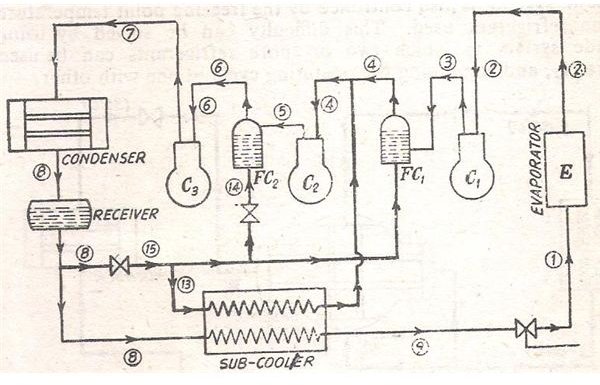
Just take a look at the diagram below and try to correlate it with what you read below that so that it makes more sense.
You will notice that this diagram represents a 3 stage compound compression system wherein the refrigerant from the evaporator passes successively through 3 stages of compression which are depicted by the compressors C1, C2 and C3 respectively. After the first two compressors there is a flash cooler depicted by FC1 and FC2.
Finally the refrigerant goes to the condenser and receiver and there is a sub-cooler in the circuit as well. The notable thing about this arrangement is that the liquid refrigerant itself is used as a coolant in the inter-cooling and sub-cooling stages. The benefits of this arrangement over using a single stage compression system are as follows.
- Suppose each compressor has a compression ratio of 5, the compression ratio required in an equivalent single stage system would be as high as 5*5*5 = 125. Hence smaller compressors can be used instead of a single huge compressor
- The refrigeration effect per kg of the refrigerant is increased due to sub-cooling.
Of course there are some disadvantages of this system as well such as increased cost, complex design and operations.
An Actual Cryogenerator
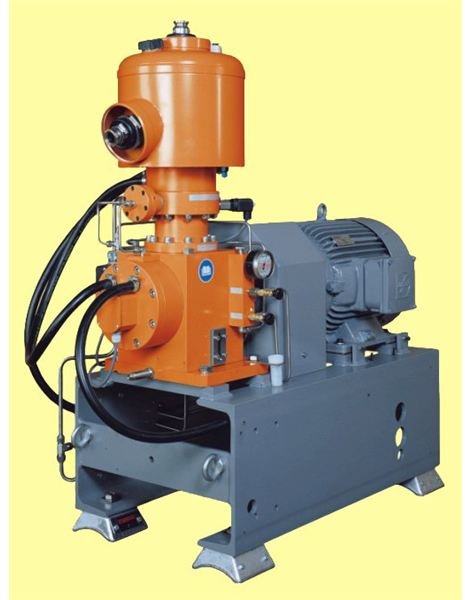
We just saw the operating principle of a typical multistage cryogenerator. Different companies have their own products which go by their brand name and use one or the other operating principle. Given here is a picture of a cryogenerator which is manufactured by a company known as Stirling Cryogenerators and most of its products are based on the Stirling Cycle which has the advantages of low noise, low power consumption and so forth. The image below shows a cryogenerator which comes with the trade name SPC-1.
References
Image of 3 Stage Compound Compression Cryogenerator - Arora, S.C. & Domkundwar, S. (1993_). A Course In Refrigeration & Air-Condioning._ Delhi: Dhanpat Rai & Sons
Image of SPC-1 Cryogenerator - Courtesy: Stirling Cryogenics and Refrigeration BV, Netherlands