Quick Take
The correct sizing of the central air conditioning and heating systems play a major role on energy expenditure. Here are a few working tips for getting better performance from a central AC and heat system.
On this page
Major Components of Central Air Conditioning and Heating Systems
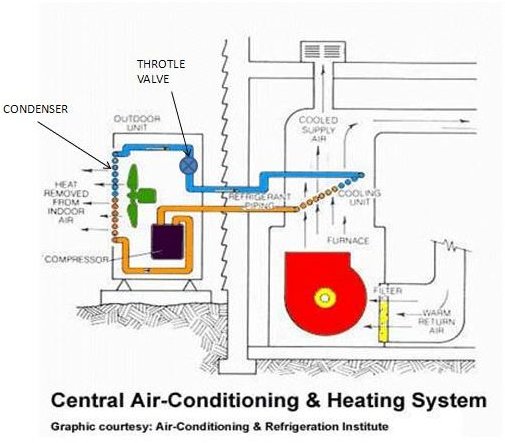
- Compressor : The compressor is responsible for maintaining the desired pressure and flow rate of the refrigerant in the air conditioning circuit.
- Condenser : The refrigerant releases heat through the condenser coil with the help of a fan. The condenser unit along with the compressor unit constitutes the outdoor unit of the central AC.
- Evaporator: This is the indoor unit of the central AC and primarily responsible for providing cooling effect to the users. The evaporator units are placed above the air circulating blower of the furnace.
- Furnace: The furnace has a blower and a heater coil. The heater may be electrical type, water heat pump type (boiler), or some other type.
- Filter: A filter is placed at the air inlet of the blower. The function of the filter is to prevent dirty air from circulating through the duct.
- Duct: The tubes that carry the air are called ducts.
How Central Air Conditioning and Heating System works
- The refrigerants after absorbing heat from the evaporator become gaseous.
- The gaseous refrigerant then gets compressed at compressor and thus, the pressure of the refrigerant increases.
- The high pressure and high temperature refrigerant then go to the condenser. Here the refrigerant is condensed (becomes liquid) after releasing heat to the atmosphere.
- The refrigerants then pass through a throttle valve, which converts the refrigerant to low temperature gas, ready to absorb more heat from evaporator.
- The blowers circulate and recirculate air in the building. The air flows over the evaporator as well as over the heater.
- In the summer season, the heater is turned off and in the winter season the AC unit is turned off. A thermostat synchronizes the heater and the AC unit to control the temperature.
A Few Practical Tips for Improving System Performance
- Duct sealing: Proper sealing of the ducts will prevent supply air leakage and entry of hot attic air to the return. Study shows that up to 20% energy saving is possible by proper sealing.
- Duct Size: Improper duct size can cause excessive pressure loss and noise. Typically maximum 8-10 m/sec is a good number for air flow in the duct.
- Thermal comfort: The system should be designed in such a way that the temperature difference between the head level and feet level should not be more that 3 degree C.
- Humidity: A relative humidity of 40-60% is considered good for human comfort .
- Thermostat selection: The selection of thermostat should be based on the types of heater used. For example a twin-switch thermostat is suitable for a water heater.
- Blower Sizing: The blower size is directly related to the air change rates, and the air change rates are guided by BS 5449: 1990.
- Cleaner is greener: Timely cleaning of the ducts, evaporator coils, condenser coils, and filters will ensure more heat exchange and thus increase efficiency.
Conclusion
The performance of your central air conditioning and heating system not only determine your physical comfort but your financial comfort as well. So, by selecting the right components for the central AC and heater, and maintaining them properly you can ensure your comfort lasts long, really long.
Reference: